Silent wear
A contactor degrades for weeks. Nothing flags it, and nothing says what to do.
Asset intelligence
Predictive and prescriptive maintenance that shows which chargers will fail, and what to do about it. Iris R-One ranks every charger by the asset health index, predicts which component will fail and when, and prescribes the fix as a remote action or a planned work order.

/Predictive Maintenance
Failure Risk
Wear builds quietly until a driver finds it.
A contactor degrades for weeks. Nothing flags it, and nothing says what to do.
Without a health ranking, crews visit the wrong chargers first.
A risk alert that never becomes a job changes nothing.
R-One flags a likely failure early enough to plan the fix. Of the chargers it predicted would fail, up to 97% actually did.
Of 100 chargers R-One predicted would fail
How R-One ranked charger failure risk for two operators, on their own history.
Case studyEuropean charge point operator
A European charge point operator fixed chargers after they failed. R-One showed where failures concentrate, and which 40% of the estate could safely wait.
Read case studyCase studyIndian fleet operator
At an Indian fleet charging hub, R-One ranked every DC charger by failure risk, and showed which 20% could safely be left alone.
Read case studyPrediction says what will fail. Prescription says what to do about it.
/Predictive Maintenance
Failure Risk
One health measure per charger, from Excellent to Failed, ranked across the network.
Component-level risk with confidence and expected timing, up to 3 weeks before failure.
Expected life per component based on duty cycle and history.
The recommended fix, ranked by impact, attached to every prediction.
The prescribed action runs remotely or becomes a condition-based job with the part reserved.
Parts demand projected from predicted failures.
The asset health index ranks every charger from telemetry, faults and service history.
Component risk and expected timing are forecast, up to 3 weeks ahead.
The recommended action is attached to each prediction.
A remote action runs, or a work order is created with the part reserved.
What the technician finds on site feeds back to the model.
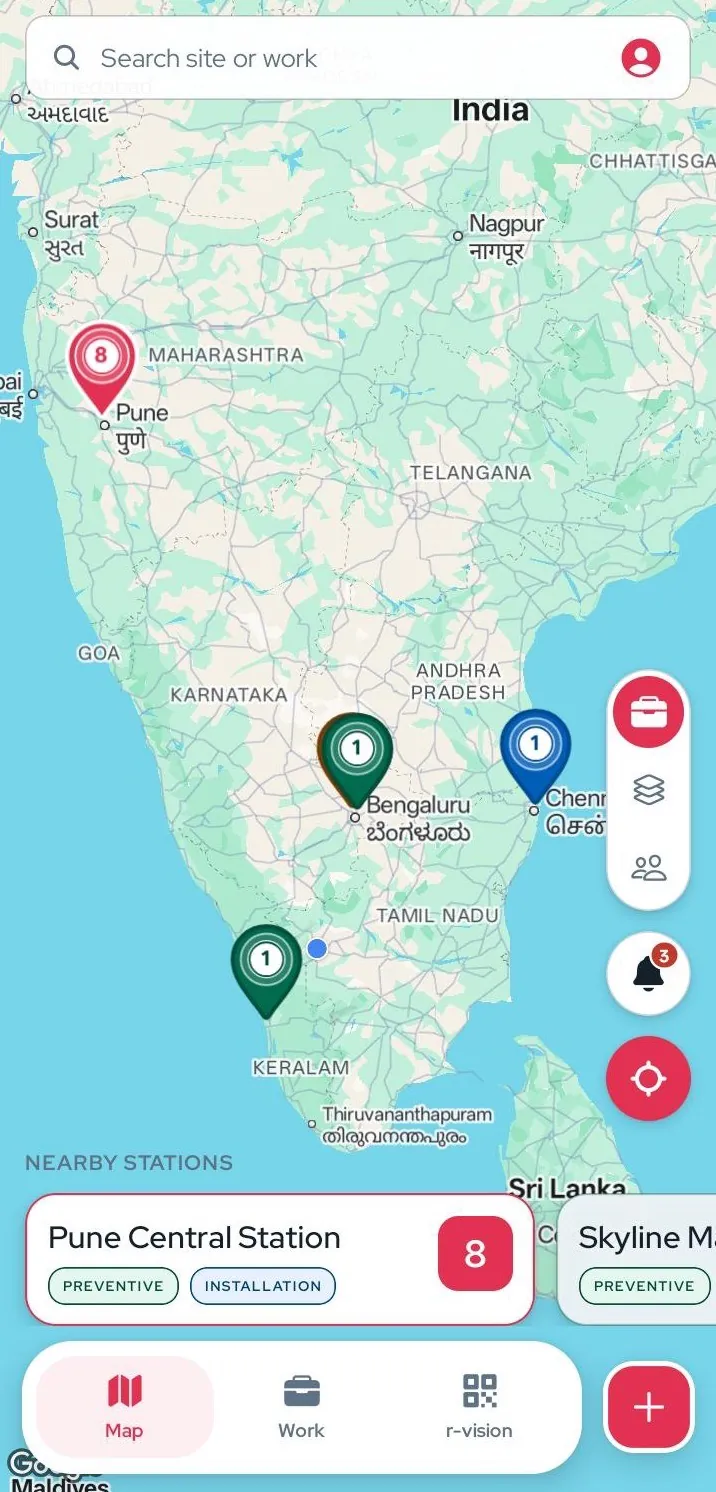
In the mobile app
The prescribed fix reaches the technician as a job with the part reserved, and what they find on site feeds back to the model.
Asset data, fault history and completed work train the prediction. Prescribed actions become jobs in maintenance.
Operators




Up to 3 weeks. R-One flags the component at risk and when it is expected to fail, early enough to plan the fix, reserve the part and schedule a visit instead of reacting to an outage.
Up to 97% of the chargers R-One predicted would fail went on to fail. Every prediction carries a confidence level, so crews can start with the chargers at highest risk.
Prescriptive maintenance goes one step past prediction. After R-One predicts which component is likely to fail and when, it prescribes what to do about it, and turns that action into a remote fix or a work order.
A single health measure per charger, built from behaviour, fault history and service data, that ranks chargers from Excellent to Failed so crews start with the highest risk.
OCPP telemetry, Logged and Derived faults, service history and asset details such as OEM, model and age.
Yes. Every completed job records what was found on site, and that outcome feeds back into the model.
Share the size and make-up of the charging network, and the walkthrough will show what R-One surfaces on it. Demos run about 40 minutes.

