Understanding OCPP 1.6 in Practice: Why “Standard” Doesn’t Always Mean Uniform
Introduction
The Open Charge Point Protocol (OCPP) is widely recognized as the industry standard for communication between electric vehicle (EV) chargers and central management systems. It was designed to enable interoperability, allowing Charge Point Operators (CPOs) to manage chargers from multiple manufacturers within a unified ecosystem.
However, while OCPP provides a standardized framework, its real-world implementation often introduces variability that impacts operations, diagnostics, and system reliability.
OCPP: Standardization vs. Implementation
At its core, OCPP defines a structured method for communication. It specifies message formats, workflows, and expected behaviors between charging stations and backend systems.
Yet, like many protocols, OCPP allows flexibility in implementation. This flexibility enables innovation across manufacturers, but it also leads to differences in how events, errors, and statuses are communicated.
A useful way to understand this is by comparing OCPP to a language.
Multiple speakers may convey the same meaning using different words, formats, or expressions. While the intent remains consistent, interpretation requires contextual understanding.
Variability Across OEM Implementations
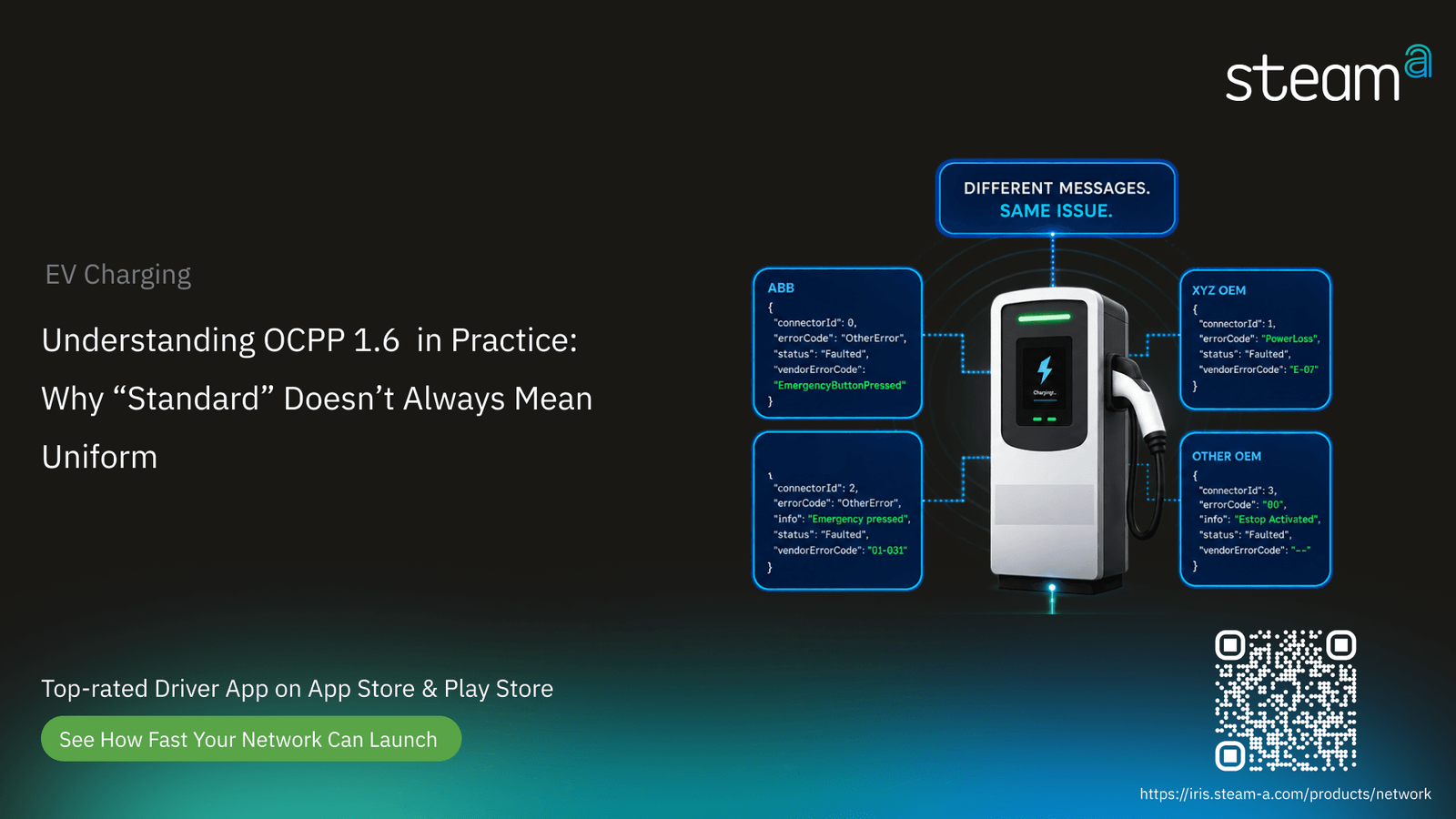
Consider a common operational scenario: A customer Pressing Emergency Stop.
Ideally, this condition would be reported consistently across all devices. In practice, however, different manufacturers may represent the same issue in distinct ways:
- ABB -
{"connectorId":0,"errorCode":"OtherError","status":"Faulted","info":"","timestamp":"2025-09-05T07:56:13.001Z","vendorId":"com.abb.evci/event/v1","vendorErrorCode":"EmergencyButtonPressed"}
- Mindra -
{"connectorId":2,"errorCode":"OtherError","info":"Emergency pressed","status":"Faulted","timestamp":"2026-08-18T02:13:35Z","vendorId":"Mindra","vendorErrorCode":"01-031"}
While each implementation remains technically compliant with OCPP, the lack of uniformity introduces complexity at the system level.
Operational Impact on Charge Point Operators
For CPOs managing multi-vendor networks, this variability creates tangible challenges.
A typical network may include:
- Multiple OEMs
- Several charger models per OEM
- Distributed deployments across numerous locations
In such environments, interpreting charger behavior becomes increasingly complex.
Support teams and field engineers must:
- Recognize patterns across different message formats
- Correlate vendor-specific codes with real-world issues
- Maintain internal knowledge bases for troubleshooting
As a result, issue resolution can become slower and more dependent on experience rather than system-driven insights.
The Need for Normalization
The underlying issue is not a flaw in OCPP itself, but a lack of standardization in how information is interpreted and presented.
Most systems today relay charger messages as-is, without applying normalization or contextual mapping.
This shifts the burden of interpretation from software to operations teams.
To address this, modern EV charging platforms must incorporate a normalization layer, one that translates diverse inputs into consistent, actionable outputs.
A Practical Approach: Intelligent Alert Normalization
To overcome these challenges, solutions such as the R-One alert system (a Predictive Charger Asset Management System designed for managing and monitoring EV chargers) introduce a structured approach to interpreting charger data.
Instead of relying on predefined mappings alone, the system:
- Identifies new or unfamiliar error patterns
- Associates them with known operational conditions
- Continuously builds a knowledge base of charger behaviors across OEMs
Over time, this enables consistent classification of issues, regardless of how they are originally reported. For example, multiple representations such as:
- PowerLoss
- PowerOutage
- Emergency Button Pressed
- Numeric fault codes
- Misplaced error fields
can all be normalized into a single, standardized insight - Power Loss at Site which reduces ambiguity and allows teams to focus on resolution rather than interpretation.
Conclusion
OCPP remains a critical enabler of interoperability in EV charging infrastructure. However, its flexibility in implementation introduces variability that must be addressed at the platform level.
For CPOs operating at scale, the ability to interpret and normalize charger communication is essential for maintaining operational efficiency and delivering a reliable charging experience. In practice, success with OCPP is not just about supporting the protocol - it is about understanding and standardizing how it is used across a diverse ecosystem.