Guide for CPOs to Choose the Right CMS: 6 Essential Things to Evaluate
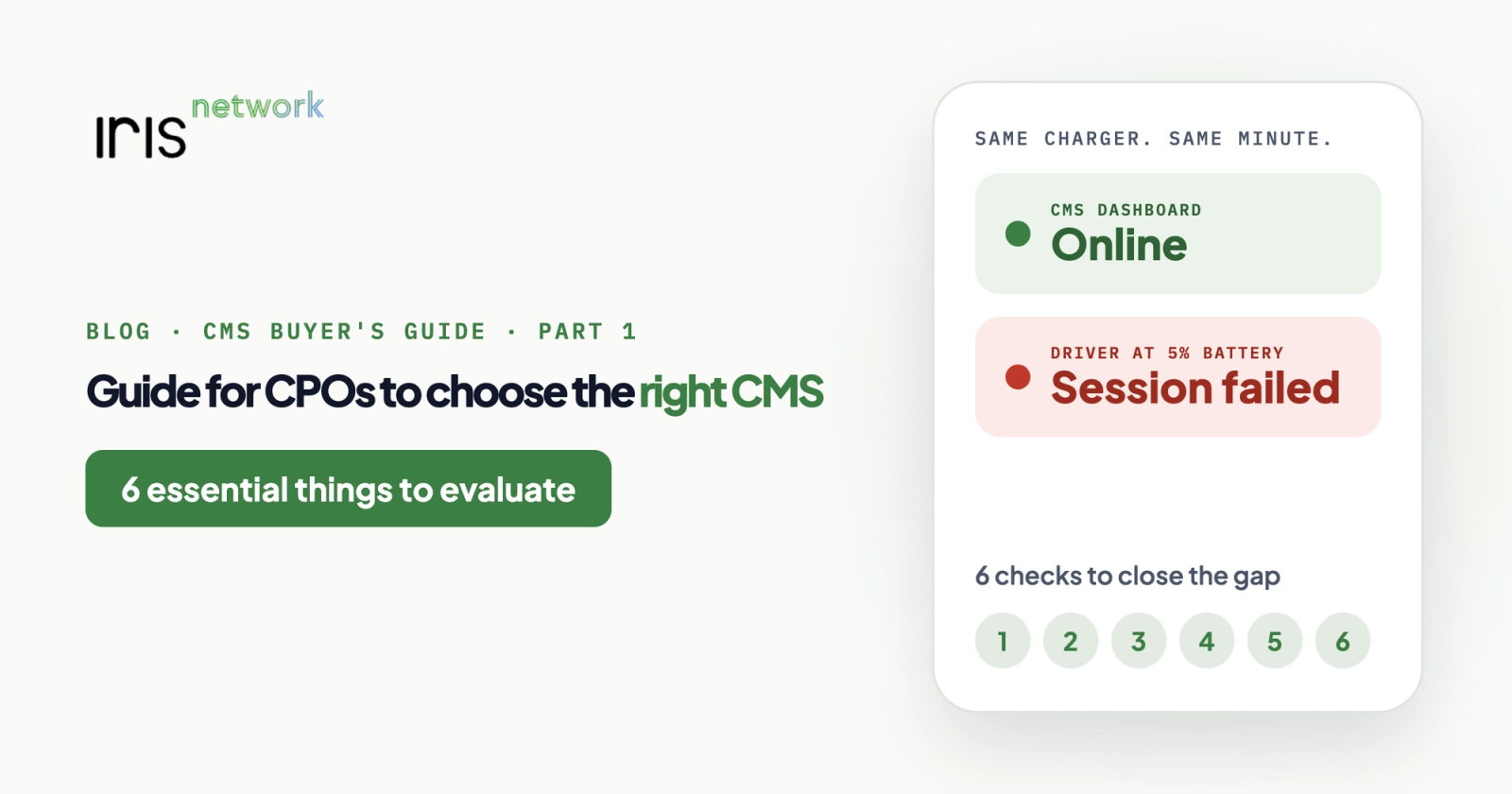
Imagine driving to a charging station with 5% battery, plugging in your vehicle, and waiting for the session to start. Nothing happens. You try again, check your app, and eventually drive away to find another station.
Now imagine being the CPO and discovering that your CMS showed the charger as online the entire time. The charger was connected. The dashboard looked fine. Yet the customer couldn't charge.
This is one of the challenges of running an EV charging network. Installing chargers is only the beginning. Keeping them reliable, managing electricity costs, handling different customer requirements, and ensuring every transaction is accounted for take considerable work behind the scenes.
A good EV charging management system (CMS) should make that work easier. But with so many platforms offering similar features, how do you know which one is right for your business?
Rather than comparing platforms by the number of features they offer, start by looking at the problems they need to solve.
1. Charger uptime is more than a green indicator
A charger has been online all day, yet three customers have reported that it wouldn't start a session. Is it really performing well?
This is why CPOs need to look beyond basic online and offline statuses. A charge point management system should help operators track charger uptime, downtime, failed sessions, and recurring faults.
Historical data matters just as much as live status. If a charger keeps failing every few days, the operations team should be able to identify the pattern and investigate the underlying cause.
The goal isn't simply to collect uptime percentages for monthly reports. It's to improve charger reliability and prevent customers from facing the same problem repeatedly.
2. When everyone plugs in at once, who gets the power?
Picture a charging depot at the end of a busy working day. Several vehicles arrive together, all needing to charge before their next trip. The site's available power, however, hasn't increased with the number of vehicles.
A CMS with smart charging and dynamic load management should distribute available power across chargers according to configured limits and priorities. This allows CPOs to manage demand without unnecessarily restricting charging or exceeding site capacity.
Effective load sharing can also help reduce avoidable demand-related costs and make better use of existing electrical infrastructure. When evaluating an EV charging management system, ask how easily charging profiles can be configured, how power is allocated, and what happens when demand changes.
The system should give operators control over their available power, not leave them guessing about how it is being used.
3. Three fleet partners, three business models. Can your CMS keep up?
Let's say you have three fleet partners. One has negotiated discounted daytime rates, another pays a fixed tariff throughout the day, and the third receives off-peak pricing. Now add regular customers, idle fees, and a session that runs past midnight into a different tariff period.
Suddenly, pricing is no longer a simple matter of entering a rate per kWh.
Your CMS should accommodate these different commercial arrangements without forcing your team to create manual workarounds for every new agreement. It should apply the correct tariffs and discounts, calculate charges accurately when pricing changes during a session, and reflect those amounts consistently in transaction reports.
Flexible EV charging tariff management becomes particularly important as networks grow and commercial agreements become more varied.
Choose a CMS that can accommodate that complexity without making every pricing change a development task.
4. Charging should be easier than finding a parking spot
Think about a first-time customer at your station. They scan a QR code, get redirected to an application, struggle with registration, and then discover they need to complete another step before charging can begin.
That's a lot to ask of someone who just wants to charge their car.
A CMS should support a smooth customer journey, from onboarding to session completion. Depending on the network's requirements, this may include QR-code charging, RFID, remote start, and AutoCharge.
AutoCharge is particularly convenient because it can minimise customer interaction once the customer and vehicle are registered and the feature is activated. But convenience only matters when the entire process works reliably.
CPOs should evaluate not just how many ways a session can be started, but how consistently those methods work in real-world conditions. Fewer unnecessary steps and clearer error messages can make a meaningful difference to the customer experience.
5. All that data, but what should you do with it?
Your CMS shows energy consumption, session counts, revenue, utilisation, and charger status. Everything looks informative. Then someone asks which chargers need attention this week, and the team starts downloading spreadsheets.
This is where good EV charging analytics make a difference.
A CMS should turn session and charger data into useful insights. CPOs should be able to identify recurring failures, understand when charging demand peaks, compare station performance, and spot chargers that aren't being used effectively. Context matters, too. Low utilisation might indicate a technical problem, but it could also mean the location has limited demand.
A useful CMS helps the operator investigate rather than jump to conclusions. The best data cards aren't necessarily the ones with the most impressive charts. They're the ones that help someone make a better decision.
6. When the session report and bank statement disagree
The session report shows one amount, the transaction report shows another, and the payment settlement doesn't match either. Someone now has to figure out what happened.
For a network handling hundreds or thousands of sessions, even small inconsistencies can create significant reconciliation work.
A CMS should maintain consistent records across charging sessions, transactions, customer balances, and financial reports. Every transaction should be traceable, and refunds, adjustments, and settlement differences should be identifiable.
This is particularly important when the business operates multiple payment methods, customer wallets, fleet accounts, and commercial agreements.
Accurate reporting isn't just convenient for the finance team. It helps CPOs trust their numbers, resolve disputes, and understand how the business is performing.
What comes next?
Reliable chargers, intelligent power management, flexible tariffs, a smooth customer experience, actionable analytics, and accurate financial records form the foundation of a well-managed charging network.
But there's another layer to consider.
What happens when your chargers come from different manufacturers? Can your CMS handle unexpected failures, scale with your network, protect sensitive data, and integrate with the wider EV charging ecosystem?
In Part 2, we'll explore the next seven factors CPOs should evaluate before choosing a CMS, from OCPP compatibility and troubleshooting to security, scalability, integrations, and real-world testing.
Because choosing the right CMS isn't just about how well it works today. It's about how well it performs when your network becomes more complex tomorrow.