Culture Is Felt Before It Is Explained
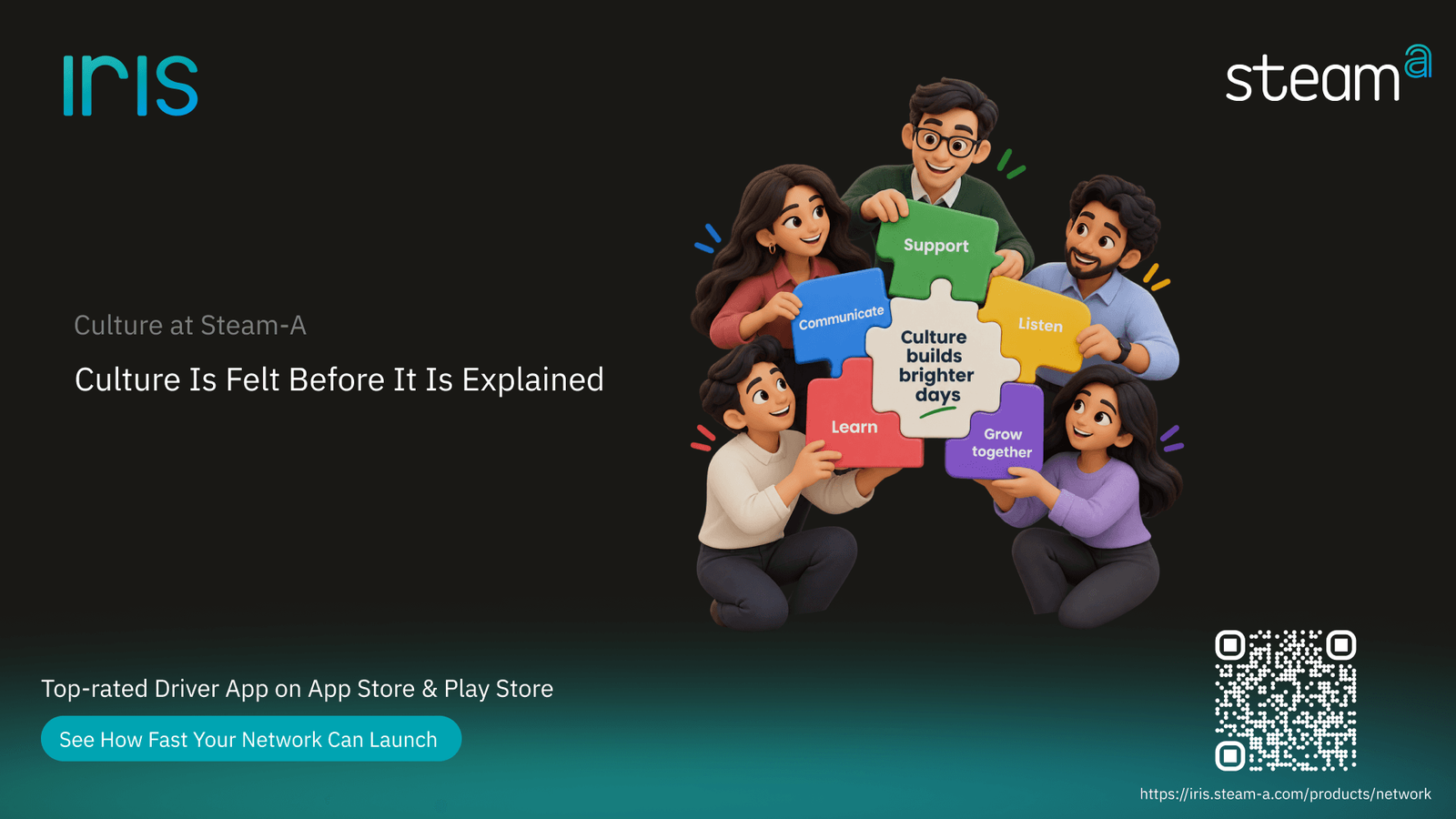
We talk about company culture quite often. But I sometimes feel we underestimate how much of our everyday work is shaped by it.
Culture is not something that becomes important only when there is an event, a celebration, a new policy, or an engagement survey. It is already there in the way we speak to each other, in the way we ask for help, in the way we respond when something goes wrong, in the way we give feedback, in the way we appreciate someone, and even in the way we handle a misunderstanding.
Culture is what keeps people connected when the work itself becomes difficult.
Every organisation will have mistaken. There will be missed deliveries, misunderstandings, disagreements, pressure, communication gaps and days when things simply don't go as planned. A good culture doesn't mean these things never happen. It means people don't immediately start assuming the worst. They talk, clarify, listen, understand what happened, and work towards fixing it.
The problem is not what makes or breaks the culture. How we handle the problem does.
Someone may make a mistake and need support instead of blame. A delivery may not happen as planned, and the immediate response may need to be, “Okay, let's understand what happened and see how we can fix it.” Two people may have misunderstood each other. Instead of carrying the assumption forward, they can simply speak to each other and sort it out.
These may sound like very small things. But repeated every day, they become the workplace.
Sometimes, you can feel that something is not right
There are days when everything looks normal from the outside. People are working, meetings are happening, projects are moving, but something feels different. The energy is not the same. The conversations are quieter. People are not interacting the way they usually do.
Even as human beings, we can sense when something is not quite right.
At Steam-A, when we sense that something is off, we don't want to simply ignore it and hope it disappears. It may come up in a town hall. It may become a discussion in a team meeting. Sometimes someone will directly approach HR or another person they feel comfortable talking to and say, “Something doesn't feel right.”
That openness matters. Because culture cannot be maintained by one person. It needs people to care enough to say when something is not working.
Questioning is also part of culture
I don't believe a healthy culture means everyone nods when someone speaks.
If something doesn't make sense, people should be able to ask: “Why are we doing this?” “Is this really the right way?” & “Can we do this differently?”
That is not disrespect. When the intent is right, questioning can actually make the organisation stronger.
At Steam-A, we have tried to create that space whether it is in a common meeting, a town hall or a direct conversation. The expectation is not that everyone should agree with everything. The expectation is that we should be able to disagree without making it personal.
And when there is a misunderstanding, talk to the person
This is probably one of the simplest things we keep reinforcing.
If something has happened between two people, go and talk to the person involved. Not everyone else. Don't build a story around something you haven't understood. Don't give a situation a title before knowing the whole story. And don't let a misunderstanding become someone else's opinion of a person. Because sometimes, one conversation can solve something that ten conversations around it cannot.
We have seen this happen internally. When people are encouraged to have a direct conversation, many things that looked much bigger from the outside become much simpler once the two people actually talk.
And the difference before and after that conversation can be very visible.The problem may not disappear immediately, but the assumption does. That itself is progress.
At Steam-A, culture is something we have consciously built
We started with writing down a culture handbook. It contains the principles and behaviours we want to build as an organisation. We take it seriously, almost like our culture Bible, but we also know that simply having a handbook does not create culture.
Living it does.And that is something we continue to work on every day.
One principle that captures this well for us is:
Appreciate in public. Criticise in private.
It sounds simple, but behind that principle is a bigger thought: correct the work without breaking the person. We don't always know what someone is dealing with internally. Someone may look confident and still be struggling. Someone may appear to understand something because it is obvious to us, while for them it may be completely new.
As an HR professional, I have learnt this particularly well. I may explain the same process every day. For me, it becomes routine. But the person sitting across from me may be hearing it for the first time.
So I cannot assume, “They should already know this.”
We cannot assume people know something simply because we know it well.
That applies to culture too.
People come from different backgrounds, different workplaces and different levels of experience. They don't all arrive knowing the same things. So culture also means giving people the space to understand, learn and adapt.
When culture becomes a common language
One of the most interesting things about culture is that, when it works, you eventually stop noticing it.
You don't need to keep reminding people to help each other. You don't need to repeatedly tell people to communicate. You don't need a policy for every small situation. People start understanding the language of the organisation. Not literally the words. The way of working.
Someone new joins, and slowly they start picking it up. How we speak. How we give feedback. How we handle mistakes. How we ask for help. How we appreciate people. How we solve disagreements.
And one day, it doesn't feel like a rule anymore. It just feels like “how we do things here.”
That is when I feel culture has really started working.
Culture becomes powerful when people start carrying it themselves
This is probably the part I value most.
Culture is not successful because HR keeps reminding everyone about it. It becomes successful when people start doing it themselves.
When a person who joined recently starts helping someone else. When someone who once needed support starts giving that same support to another colleague. When people themselves say, “Let's talk to the person directly.” When someone questions something because they genuinely want it to be better. When appreciation starts coming naturally. When people understand that a disagreement does not have to become a conflict.
That is when culture starts becoming inculcated into the way the organisation works. You no longer have to keep saying, “This is our culture.”
People simply start saying, “This is how we do things here.”
There is data behind this too
Gallup's latest organisational culture data shows that only 20% of U.S. employees strongly agree that they feel connected to their organisation's culture.
But employees who strongly feel connected to their culture are 4.3 times as likely to be engaged, 47% less likely to be looking for another job, and 62% less likely to experience frequent burnout.
That makes culture much more than a feel-good HR topic. It affects how people experience work.
And one finding from Gallup particularly stood out to me: employees who strongly agree that their leaders are committed to their organisation's cultural values are 9.8 times as likely to rate their workplace culture as excellent.
That is a reminder that culture cannot simply be delegated. People watch what leaders do. Then they learn what is acceptable. Microsoft describes its culture as both an input and an output and says its growth mindset requires people to keep learning, experimenting and improving rather than treating culture as something fixed.
I think that is a useful way to look at culture. It is never finished.
We are still building ours
I don't think any organisation can say its culture is finished.
At Steam-A, we are still learning, correcting, discussing and improving. People will make mistakes. There will be misunderstandings. There will be moments when we get something wrong.
But if people feel comfortable enough to raise it, question it, discuss it and solve it that itself is a sign that the culture is alive.
Every time a team handles a difficult situation in the right way, the culture becomes a little stronger. Every time someone chooses a conversation over an assumption, it becomes stronger. Every time someone supports another person instead of simply pointing out their mistake, it becomes stronger.
And every time people feel safe enough to say, “I don't know,” “I made a mistake,” or “I need help,” and still know they will be treated with respect, it becomes stronger.
Maybe that is what culture really is.
Not a perfect workplace. Not a handbook sitting on a shelf. Not a set of words we repeat because they sound good. It is the invisible way people learn to work with each other. You don't build it once and protect it forever. You build it every day through the way people treat each other.
And when everyone walks into the workplace and starts feeling that same sense of “this is how we treat people here,” you don't need to explain the culture anymore.
People can feel it.
And perhaps that is when you know it is working.